进展 | 赵瑞琳团队系统解析裸盖菇素生物合成基因簇的起源与演化机制
2026-01-28 09:50 来源:以下文章来源于科微学术,作者赵瑞琳团队等
近日,中国科学院微生物研究所微生物多样性与资源创新利用全国重点实验室赵瑞琳研究团队在国际真菌学期刊 Mycosphere 上发表题为 “Evolution and Horizontal Transfer of the Psilocybin Biosynthetic Gene Cluster Drive the Diversification of Magic Mushrooms” 的研究论文,系统解析了裸盖菇素(psilocybin)生物合成基因簇的起源、演化历程及其在真菌多样化中的潜在作用。

裸盖菇素是一类存在于部分真菌中的重要次生代谢产物,因其对人类神经系统具有显著生理效应而备受关注,但其在自然界中的起源与进化机制长期缺乏系统认识。
研究团队对来自10个属的30种潜在裸盖菇素产生真菌开展了 PacBio 长读长全基因组测序,并结合细菌、植物和真菌等20608个代表性基因组进行比较分析。结果表明,裸盖菇素生物合成基因簇并非源自细菌或植物的水平基因转移,而更可能起源于真菌自身基因的重复、功能分化及基因组重排,并在后续演化过程中多次发生跨谱系水平转移和结构重构。研究共鉴定出4次独立的基因簇水平转移事件,并解析了3种不同的基因簇结构类型。结合转录与代谢分析发现,裸盖菇素生物合成具有显著的发育阶段特异性,其关键合成基因在菌丝阶段受到严格调控,与菌丝体中未检测到裸盖菇素的实验结果一致。
系统发育与分化时间推断显示,裸盖菇素产生真菌在白垩纪—第三纪灭绝事件后快速辐射演化,与哺乳动物兴起及草原、粪生等新生态位的形成高度相关。进一步的泛基因组分析表明,裸盖菇素生物合成基因簇的获得显著促进了真菌遗传创新,有助于物种多样化与生态适应。
综合多项证据,研究提出了裸盖菇素生物合成基因簇经历“真菌内源起源—水平转移扩散—强烈纯化选择维持”的演化模型,为理解真菌次生代谢基因簇的形成与演化机制提供了新的理论框架。
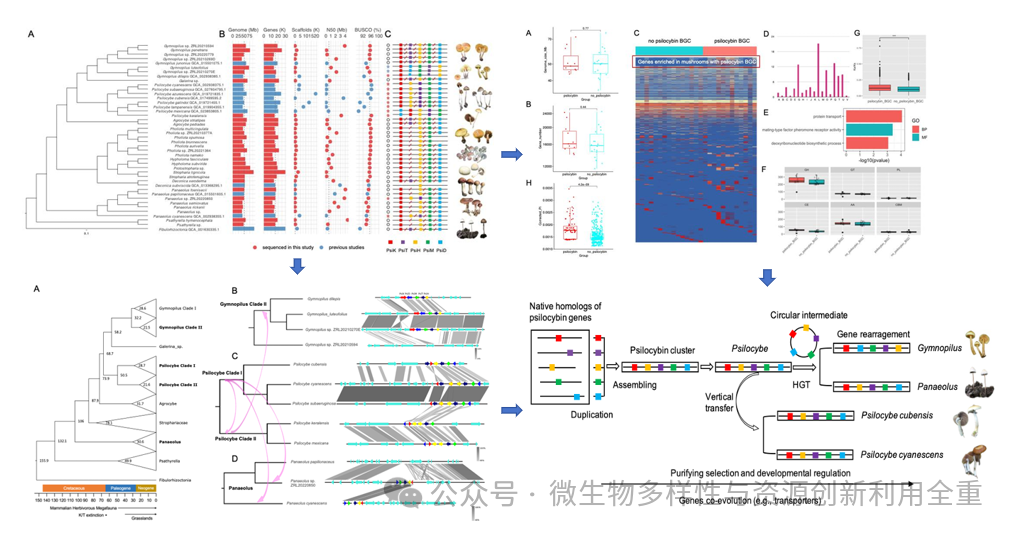
图1 本研究图形摘要
中国科学院微生物研究所刘飞助理研究员和李贾鑫博士研究生为论文共同第一作者,赵瑞琳研究员为论文通信作者。本研究得到国家自然科学基金、中国科学院生物资源计划等项目的资助。
Abstract
Psilocybin, the psychoactive compound responsible for the hallucinogenic effects of “magic mushrooms,” is synthesized by a biosynthetic gene cluster (BGC) traditionally associated with Psilocybe species. However, psilocybin production has also been identified in multiple genera across the Strophariaceae, Hymenogastraceae, and Galeropsidaceae families. Here, we sequenced the genomes of 30 putative psilocybin-producing mushroom species from ten genera using PacBio long-read technology. Comparative analysis across 20608 bacterial, plant, and fungal genomes indicates that the psilocybin BGC most likely originated from endogenous fungal homologs through gene duplication and rearrangement, rather than horizontal gene transfer (HGT) from non fungal sources. We identified four independent HGT events and three distinct BGC configurations, and propose an evolutionary framework integrating vertical inheritance, HGT, and strong purifying selection. Transcriptomic profiling revealed high expression of PsiK during the mycelial stage, while PsiH and PsiM remained inactive—correlating with the absence of psilocybin in mycelial tissue confirmed by UHPLC-MS/MS, and suggesting stage-specific regulation. Divergence time estimation, coupled with the coprophilous habit of most psilocybin-producing species, supports a post-Cretaceous-Tertiary radiation coinciding with the rise of mammals and novel ecological niches such as grasslands and dung substrates. Pangenomic analysis further reveals that horizontal BGC transfer contributes substantially to genetic innovation, facilitating species diversification and ecological adaptation. These findings highlight the pivotal role of secondary metabolites in fungal evolution and provide a genomic foundation for future research on psilocybin biosynthesis and its therapeutic potential.
TOP排行
- 你好,微朋友——四川省微生物学会携手四川师范大学成功举办科普开放日活动
- 联学共建促科普 深地科学筑梦想——四川省微生物学会专家科普讲座走进西昌怀远学校
- 四川省微生物学会参加首届中国酒业产教融合高质量发展大会
- 中国微生物学会第十四届地质微生物学学术研讨会拟于4 月在兰州召开
- 成都生物所胡军华团队合作揭示数据提质助力中国生物多样性保护再续佳绩
- 微生物所团队合作揭示镰孢菌在高原农田生态系统的分布格局并定名描述“墨脱镰孢”等藏南新种
- 进展 | 赵瑞琳团队系统解析裸盖菇素生物合成基因簇的起源与演化机制
- 微生物所叶健团队发表植物病毒虫媒传播评述文章
- 微生物所叶健团队揭示机械力受体PIEZO1介导的植物力学抗虫免疫新机制
- 四川省微生物学会跨界搭台 《梅花新韵》,奏响科艺融合新乐章